
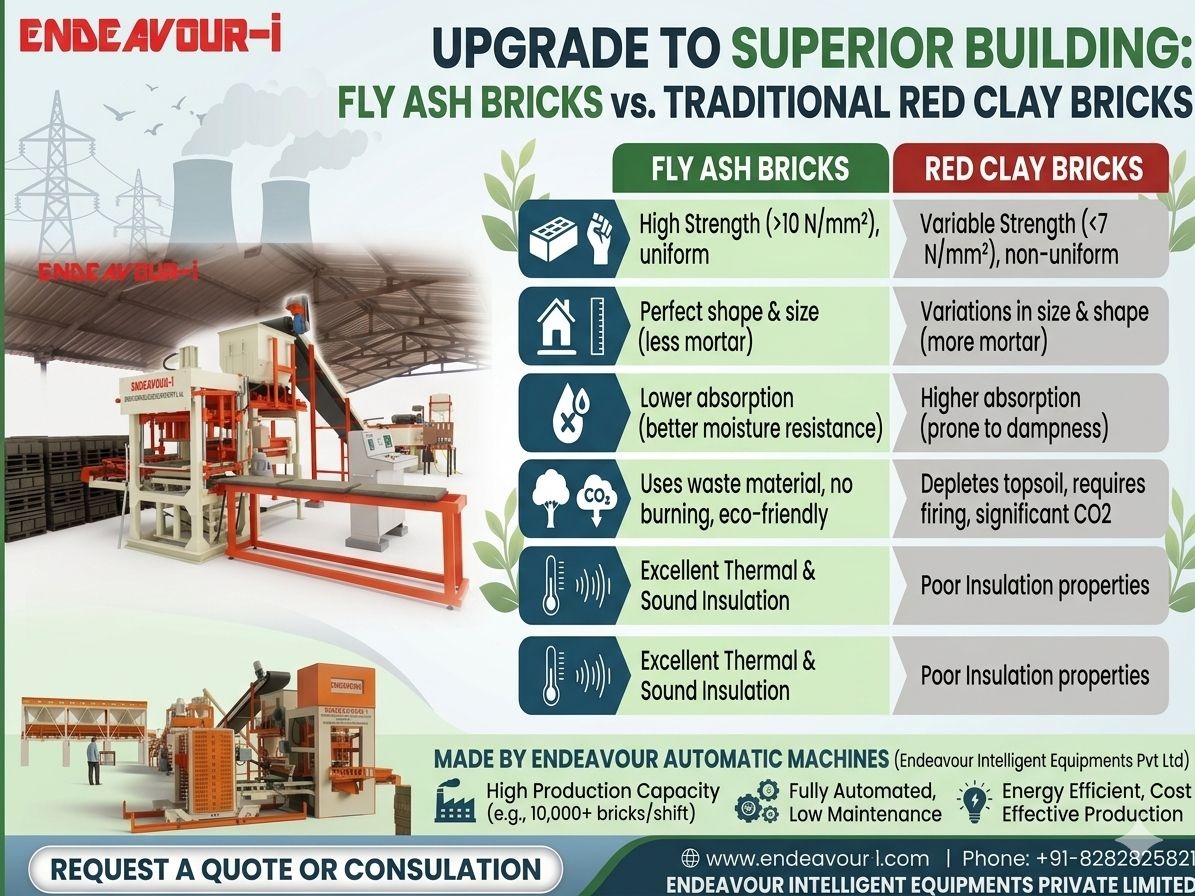
## Technical Comparison: Fly Ash Bricks vs. Traditional Red Clay Bricks When selecting masonry units for modern construction, the choice between *Fly Ash Bricks* and *Traditional Red Clay Bricks* significantly impacts a project's structural integrity, cost-efficiency, and environmental footprint. Below is an in-depth breakdown of how they compare across critical engineering parameters. ### 1. Mechanical Strength & Durability * *Fly Ash Bricks:* Manufactured using high-pressure automatic machines, these bricks possess a high compressive strength, typically exceeding *10text{ N/mm}^2* to *15text{ N/mm}^2* depending on the mix design. Because they cure rather than fire, they continue to gain strength over time in the presence of moisture. * *Red Clay Bricks:* Hand-molded or extrusion-molded and subsequently kiln-fired, their strength is highly variable, often falling below *7text{ N/mm}^2*. They are prone to inconsistencies due to uneven heat distribution during the firing process. ### 2. Dimensional Accuracy & Mortar Consumption * *Fly Ash Bricks:* Produced in precise steel molds under hydraulic pressure, they offer *perfect shape and uniform size*. The sharp, defined edges mean that consecutive brick courses require significantly less mortar (20% to 30% reduction) to achieve a level joint. Furthermore, the uniform surface minimizes or entirely eliminates the need for thick internal plastering. * *Red Clay Bricks:* Thermal warping during the kiln-burning process leads to noticeable variations in size and shape. To compensate for these uneven dimensions, masons must use thicker mortar joints, increasing overall cement and sand consumption on-site. ### 3. Water Absorption & Weather Resistance * *Fly Ash Bricks:* They exhibit a low water absorption rate, generally between *6% to 12%*. This low porosity minimizes the capillary action that draws moisture into walls, dramatically reducing the risk of dampness, interior paint peeling, and structural weathering. * *Red Clay Bricks:* High porosity allows them to absorb anywhere from *15% to 25%* of their weight in water. This high absorption rate can rob moisture from the wet bedding mortar during construction (weakening the bond) and leaves the finished structure highly susceptible to efflorescence (salt staining) and damp walls. ### 4. Thermal & Sound Insulation * *Fly Ash Bricks:* They feature a lower thermal conductivity compared to dense clay bricks, providing *excellent thermal insulation*. Buildings constructed with fly ash bricks stay naturally cooler in summer and warmer in winter, directly translating into energy savings for heating and cooling systems. They also provide a superior acoustic barrier due to their uniform density. * *Red Clay Bricks:* Clay possesses higher thermal conductivity, meaning heat transfers through the walls much faster, increasing the building's reliance on artificial air conditioning. ### 5. Environmental Impact & Sustainability * *Fly Ash Bricks:* Highly eco-friendly. They utilize industrial fly ash (a byproduct of thermal power plants), preventing it from entering landfills. Because they are cured using water or steam rather than being fired in a kiln, their production releases virtually zero greenhouse gases and consumes no fertile topsoil. * *Red Clay Bricks:* The manufacturing process is highly destructive to local ecosystems. It depletes valuable, fertile agricultural topsoil and relies on coal-fired brick kilns that emit massive quantities of carbon dioxide (CO_2) and particulate matter into the atmosphere. ## Engineering Summary Table | Parameter | Fly Ash Bricks | Traditional Red Clay Bricks | |---|---|---| | *Compressive Strength* | | Fly Ash Bricks | High & Uniform (>10 N/mm^2) | Traditional Red Clay Bricks | Variable & Lower (<7 N/mm^2) | | *Dimensional Tolerance* | | Fly Ash Bricks | Excellent (Machine-molded, sharp edges) | | Traditional Red Clay Bricks | Poor (Distorts during kiln firing) | | *Water Absorption* | | Fly Ash Bricks | Low (6% - 12%) | | Traditional Red Clay Bricks | High (15% - 25%) | | *Efflorescence Risk* | | Fly Ash Bricks | Nil / Very Low | | Traditional Red Clay Bricks | High (Prone to white salt patches) | | *Mortar & Plaster Cost* | | Fly Ash Bricks | Reduced due to uniform shape | | Traditional Red Clay Bricks | Higher due to structural irregularities | | *Sustainability* | | Fly Ash Bricks | Uses recycled materials; zero burning | | Traditional Red Clay Bricks | Consumes topsoil; high carbon emissions | >*Industrial Advantage:* Utilizing high-capacity, fully automated machinery manufactured by Endeavour Intelligent Equipments Pvt Ltd ensures that every single block meets strict structural tolerances. This rigorous consistency eliminates on-site wastage from breakage, speeding up construction timelines while delivering a significantly stronger, more cost-effective building envelope. Please Contact us for more details: ENDEAVOUR INTELLIGENT EQUIPMENTS PRIVATE LIMITED Survey No: 1206, At: Motap, Ta: Becharaji, Dist: Mehsana, Modhera Road, Mehsana, Gujarat - 384410 E Mail: endeavourintelligent@gmail.com Website: www.endeavour-i.com Contact: +91-8282825821 +91-8282825822


This is your website preview.
Currently it only shows your basic business info. Start adding relevant business details such as description, images and products or services to gain your customers attention by using Boost 360 android app / iOS App / web portal.
## Technical Comparison: Fly Ash Bricks vs. Traditional Red Clay Bricks
2026-06-14T05:22:05
## Technical Comparison: Fly Ash Bricks vs. Traditional Red Clay Bricks When selecting masonry units for modern construction, the choice between *Fly Ash Bricks* and *Traditional Red Clay Bricks* significantly impacts a project's structural integrity, cost-efficiency, and environmental footprint. Below is an in-depth breakdown of how they compare across critical engineering parameters. ### 1. Mechanical Strength & Durability * *Fly Ash Bricks:* Manufactured using high-pressure automatic machines, these bricks possess a high compressive strength, typically exceeding *10text{ N/mm}^2* to *15text{ N/mm}^2* depending on the mix design. Because they cure rather than fire, they continue to gain strength over time in the presence of moisture. * *Red Clay Bricks:* Hand-molded or extrusion-molded and subsequently kiln-fired, their strength is highly variable, often falling below *7text{ N/mm}^2*. They are prone to inconsistencies due to uneven heat distribution during the firing process. ### 2. Dimensional Accuracy & Mortar Consumption * *Fly Ash Bricks:* Produced in precise steel molds under hydraulic pressure, they offer *perfect shape and uniform size*. The sharp, defined edges mean that consecutive brick courses require significantly less mortar (20% to 30% reduction) to achieve a level joint. Furthermore, the uniform surface minimizes or entirely eliminates the need for thick internal plastering. * *Red Clay Bricks:* Thermal warping during the kiln-burning process leads to noticeable variations in size and shape. To compensate for these uneven dimensions, masons must use thicker mortar joints, increasing overall cement and sand consumption on-site. ### 3. Water Absorption & Weather Resistance * *Fly Ash Bricks:* They exhibit a low water absorption rate, generally between *6% to 12%*. This low porosity minimizes the capillary action that draws moisture into walls, dramatically reducing the risk of dampness, interior paint peeling, and structural weathering. * *Red Clay Bricks:* High porosity allows them to absorb anywhere from *15% to 25%* of their weight in water. This high absorption rate can rob moisture from the wet bedding mortar during construction (weakening the bond) and leaves the finished structure highly susceptible to efflorescence (salt staining) and damp walls. ### 4. Thermal & Sound Insulation * *Fly Ash Bricks:* They feature a lower thermal conductivity compared to dense clay bricks, providing *excellent thermal insulation*. Buildings constructed with fly ash bricks stay naturally cooler in summer and warmer in winter, directly translating into energy savings for heating and cooling systems. They also provide a superior acoustic barrier due to their uniform density. * *Red Clay Bricks:* Clay possesses higher thermal conductivity, meaning heat transfers through the walls much faster, increasing the building's reliance on artificial air conditioning. ### 5. Environmental Impact & Sustainability * *Fly Ash Bricks:* Highly eco-friendly. They utilize industrial fly ash (a byproduct of thermal power plants), preventing it from entering landfills. Because they are cured using water or steam rather than being fired in a kiln, their production releases virtually zero greenhouse gases and consumes no fertile topsoil. * *Red Clay Bricks:* The manufacturing process is highly destructive to local ecosystems. It depletes valuable, fertile agricultural topsoil and relies on coal-fired brick kilns that emit massive quantities of carbon dioxide (CO_2) and particulate matter into the atmosphere. ## Engineering Summary Table | Parameter | Fly Ash Bricks | Traditional Red Clay Bricks | |---|---|---| | *Compressive Strength* | | Fly Ash Bricks | High & Uniform (>10 N/mm^2) | Traditional Red Clay Bricks | Variable & Lower (<7 N/mm^2) | | *Dimensional Tolerance* | | Fly Ash Bricks | Excellent (Machine-molded, sharp edges) | | Traditional Red Clay Bricks | Poor (Distorts during kiln firing) | | *Water Absorption* | | Fly Ash Bricks | Low (6% - 12%) | | Traditional Red Clay Bricks | High (15% - 25%) | | *Efflorescence Risk* | | Fly Ash Bricks | Nil / Very Low | | Traditional Red Clay Bricks | High (Prone to white salt patches) | | *Mortar & Plaster Cost* | | Fly Ash Bricks | Reduced due to uniform shape | | Traditional Red Clay Bricks | Higher due to structural irregularities | | *Sustainability* | | Fly Ash Bricks | Uses recycled materials; zero burning | | Traditional Red Clay Bricks | Consumes topsoil; high carbon emissions | >*Industrial Advantage:* Utilizing high-capacity, fully automated machinery manufactured by Endeavour Intelligent Equipments Pvt Ltd ensures that every single block meets strict structural tolerances. This rigorous consistency eliminates on-site wastage from breakage, speeding up construction timelines while delivering a significantly stronger, more cost-effective building envelope. Please Contact us for more details: ENDEAVOUR INTELLIGENT EQUIPMENTS PRIVATE LIMITED Survey No: 1206, At: Motap, Ta: Becharaji, Dist: Mehsana, Modhera Road, Mehsana, Gujarat - 384410 E Mail: endeavourintelligent@gmail.com Website: www.endeavour-i.com Contact: +91-8282825821 +91-8282825822
2026-06-14T05:22:05


Submit Your Enquiry